
How to Create a Mind Map | Examples, Templates & Tips
If you’ve ever zoned out while reading a textbook chapter or struggled with writer’s block, mind mapping might be your new favorite study tool.
Like an outline, a mind map organizes information into categories and supporting details, but it shows how ideas connect instead of presenting them in a linear format. Mind maps save time and boost success in two ways:
- Studying a textbook chapter: Mapping the topic, section headings, and key terms encourages active learning and helps you remember information more effectively.
- Writing an essay: Planning your main idea, body paragraph topics, and supporting details gives you a clear roadmap before you start drafting.
Whether you’re studying for an exam or planning a paper, you can create a mind map with pen and paper or an online design tool, and it can be as simple or detailed as you need.
In this guide, you’ll learn how to create a mind map for studying and writing, explore examples, and discover templates that you can download for free.
If you’d like to create your own mind map template from scratch, Quillbot’s Image Generator is a fast and free option.
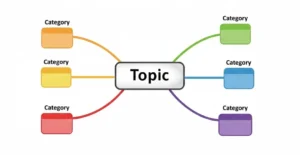
Basic mind map template
Key takeaways
- A mind map is a visual way to organize information by placing a main topic in the center and branching out to related categories and supporting details.
- Mind maps help you study more effectively because creating them is a form of active learning that makes information easier to understand and remember.
- Mind maps can improve your writing process by helping you brainstorm ideas, organize body paragraphs, and overcome writer’s block before you start drafting.
- Creating a mind map is simple: start with a central idea, add the main categories, and branch out with key details, examples, or evidence.


What is a mind map?
A mind map is a graphic organizer that starts with a central topic and branches outward into related ideas.
The main topic sits in the center of the page. From there, you create branches for major categories, concepts, or themes. Each category can branch into smaller details, like examples or definitions.
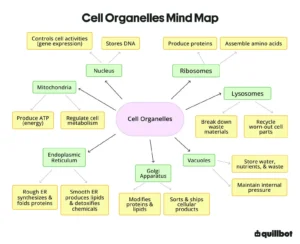
For example, a student learning about cell organelles would place “cell organelles” in the center of the page and create branches for the nucleus, mitochondria, ribosomes, and other organelles. A student planning an argument essay would place the main argument in the center and create branches for the reasons, which would have additional branches for evidence.
Unlike a traditional outline, a mind map shows relationships between ideas at a glance. The visual structure makes complex topics or writing tasks less daunting.
Cellular biology mind map example
Why use mind maps?
Even though a mind map might seem like an extra step, it actually makes studying and writing way more efficient. Mind maps help you study smarter, not harder, because they:
- Match the way that your brain organizes information
- Support active learning (actively making something instead of passively re-reading)
- Give you visual associations, which help you learn information faster
Mind maps also speed up the writing process because they:
- Unlock creativity and let your ideas flow more freely
- Help you fine-tune your essay’s structure before it’s too late
- Prevent writer’s block by giving you a clear plan
How to create a mind map
Whether you’re writing an essay or studying for a test, it only takes three steps to create a mind map.
- Start with the main topic: Write the main topic in the center of the page, and draw a circle, square, or other shape around it.
- Add the main categories: Draw branches extending from the center, and label them with the major categories related to the topic. For an essay, the major categories are the body paragraph topics. For a textbook chapter, the major categories are usually the subheadings.
- Add supporting details: For each of the main categories, draw additional branches for the supporting details, which might include examples, evidence, definitions, dates, or important people (like your outside sources or the people you’re studying).
Mind map examples
These examples illustrate the basic format for mapping a textbook chapter and an essay.
Textbook chapter mind map
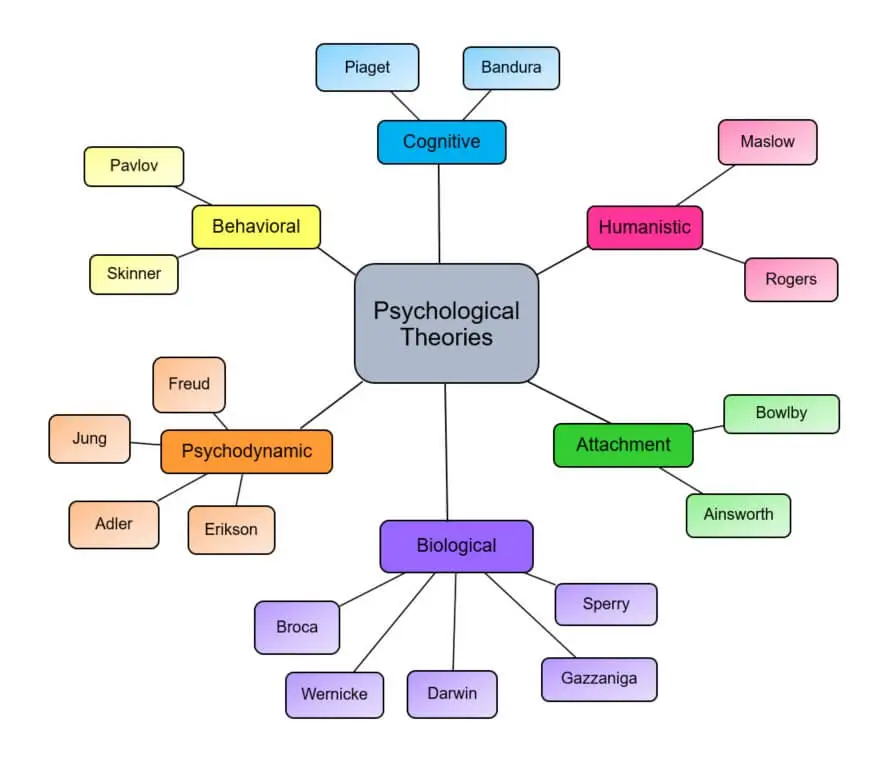
The first example for a textbook chapter includes the main topic in the center (Psychological Theories) and the five main categories (Biological, Behavioral, Cognitive, Psychodynamic, Humanistic, and Attachment). For each category, there are additional branches for the major theorists.
Mind map example: Psychological theories
Essay mind map
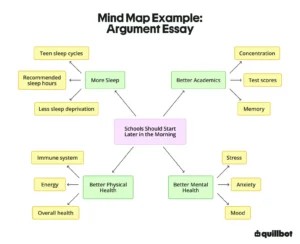
The next example shows how to map an argument essay with the main argument in the center and branches for each reason. Each reason has additional branches that provide the evidence the writer plans to use in the body paragraphs.
Mind map example: Argument essay
Mind map templates
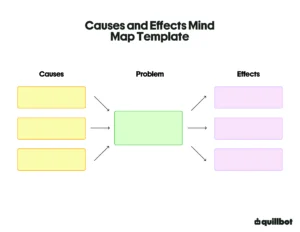
Below are two mind map templates that you can download and print for free. The first template is a mind map for causes and effects. Whether you’re mapping causes and effects for an essay or a test, you can download this free template here.
Causes and effects mind map template
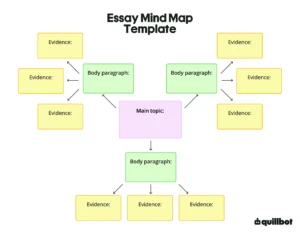
Working on a 5-paragraph essay? Download Quillbot’s free Essay Mind Map Template here.
Essay mind map template
Frequently asked questions about how to create a mind map
- What is a mind map in writing?
-
A mind map in writing is a visual representation of your main idea, body paragraphs, and supporting details. You can use it as a prewriting strategy to organize your ideas before writing an essay. For example, if you’re writing an argumentative essay, make a mind map by following these steps:
- Write your main topic/argument in a circle in the center of the page. (This will eventually become your thesis statement.)
- Make a branch and a circle for each body paragraph. Write a different reason for your argument in the center of each circle.
- Make additional branches and circles for the supporting details you’re considering for each body paragraph.
As you create a mind map for an essay, Quillbot’s AI Chat can help you brainstorm ideas or give you feedback on the body paragraph topics you’re considering.
Other interesting articles
If you want to know more about colors, letters, or the meaning of emojis, make sure to check out some of our other articles with explanations and examples.Cite this Quillbot article
We encourage the use of reliable sources in all types of writing. You can copy and paste the citation or click the "Cite this article" button to automatically add it to our free Citation Generator.
Routh, N. (2026, June 25). How to Create a Mind Map | Examples, Templates & Tips. Quillbot. Retrieved June 26, 2026, from https://quillbot.iskillspk.com/blog/education/how-to-create-a-mind-map/
